UK subtitled/captioned cinema - How it all works...
News blog by: Dean, Manager, YourLocalCinema (and profoundly deaf film fan).
 NOTE:
Caption tracks are subtitle tracks with extra 'sound' information such as 'phone rings', 'footsteps approaching' etc. When people with hearing loss talk about 'subtitles' we're often referring to captions!
NOTE:
Caption tracks are subtitle tracks with extra 'sound' information such as 'phone rings', 'footsteps approaching' etc. When people with hearing loss talk about 'subtitles' we're often referring to captions!
Latest news:
Subtitle glasses!
WatchWord subtitle/caption glasses are available for cinemas to purchase or rent.
Details here:
https://www.watchword.cc
Locations
here
Odeon 'How to use' guide here
Info for cinemas
here
A phone-style device is also available for cinemas to purchase
(Dolby Access Solution).
Details here:
https://vimeo.com/712959045
and here:
https://www.isdcf.com/wp-content/uploads/2025/01/Dolby-Accessibility-Solution_ISDCF-captions-Device-Plugfest-Jan2025.pdf
Why can't film fans with hearing loss attend cinemas whenever they want to?
The main barrier is the lack of convenient and sociable opportunities to attend accessible subtitled or captioned screenings.
Most cinema releases include a subtitle or caption track. Cinemas can make screenings accessible simply by switching that track on. In other words, cinemas already have the ability to provide accessible screenings.
Cinemas usually schedule captioned screenings in advance so audiences know that a particular show will include subtitles or captions. They generally avoid turning captions on “on demand”, because the screening may have already been advertised and sold as a non-captioned show.
Each year YourLocalCinema promotes around 100,000 accessible English-language captioned screenings across the UK and Ireland, covering more than 400 different films. In 2025 these screenings attracted an estimated 1.8 million attendees.
In addition, around 300,000 foreign-language subtitled screenings are promoted. These do not include non-dialogue audio descriptions, so they are not fully accessible, but many film fans with hearing loss still enjoy them.
Currently only about 1% of English-language cinema screenings in the UK are captioned. Most cinemas provide between one and four captioned screenings per week, often during mid-week daytime periods when many people are at work or school.
The most popular cinema times are weekend evenings. Across the entire UK and Ireland there are usually fewer than 50 captioned screenings on Friday or Saturday evenings each week. As a result, many people who would like to watch films at the cinema simply cannot find a convenient opportunity.
A recent RNID/BFI report found that 97% of people with hearing loss said they would attend the cinema regularly if nearby venues offered captioned screenings at convenient times.
The BBC programme Rip Off Britain (May 2022) found that in a typical week, out of roughly 3,000 screenings across Odeon, Cineworld and Vue cinemas, only about 30 were captioned. That is around 1% of screenings. Less than 1% of those took place on Friday or Saturday evenings, the most popular times for going to the cinema.
Clips
HERE
and
HERE
On the UK's 2022 National Cinema Day, when tickets cost £3, more than 20,000 screenings took place nationwide. Only 22 English-language screenings were captioned.
When Cineworld opened a new cinema in Hounslow in 2022, it screened around 200 foreign-language subtitled films during its first two weeks, but only two English-language captioned screenings.
See links listed earlier above
Sep 2025:
ODEON to offer
WatchWord subtitle/caption glasses at these locations:
Bournemouth, Bridgend, Dundee, Gateshead Metrocentre, Glasgow Quay, Guildford, Liverpool One, London - Acton, London - Leicester Square, Maidstone, Northampton, Norwich, Tamworth, Taunton.
Details
HERE
British Deaf Association - OCTOBER 2024:
Andy Leyshon, Chief Executive, Film Distributors' Association: ‘We should all be striving to improve accessibility and enhance the audience experience in cinemas ... We also know that there is a general increase in audiences choosing to watch subtitled content either on mobile devices or at home watching TV content – 61 percent of 18–24-year-olds and 13 percent of 50–64-year-olds, equating to over a quarter of the population – suggesting that subtitled/captioned shows are now more likely to be accepted by general audiences, not just the deaf community.’
Phil Clapp, Chief Executive, UKCA: ‘Our joint goal is to make the cinema experience even more accessible for deaf audiences, from the moment guests enter the cinema to the moment they leave, and for all cinemas to be a place that the deaf community knows it can rely on.’
https://bda.org.uk/news-release-paramount-pictures-uk/
UK film industry:
"There has been a push to provide more open subtitled/captioned screenings for a broader range of films at more desirable times e.g. evenings and weekends. Yet, attendance for many subtitled/captioned performances at those peak times is typically lower than equivalent non-subtitled/captioned screenings, suggesting that the wider audience – if given the choice – remain resistant to such screenings, with an inevitable impact on admissions and box office. This is despite increasing evidence that younger audiences in particular are more receptive to engaging with on-screen subtitled/captioned films.
In 2024 Paramount partnered with the British Deaf Association (BDA) and a selection of cinemas (including nationwide chains) to provide a suite of deaf awareness and British Sign Language (BSL) training for frontline cinema staff alongside subtitled/captioned-only preview screenings for several high-profile releases including Gladiator II and Sonic the Hedgehog 3.
The overwhelmingly positive response to these screenings suggested that audiences are perhaps less concerned with subtitles/captions and reinforced the importance of audiences wanting to see a film first.
Access Technology
Recent years have seen new technology deliver more personalised app-based and adaptive accessible solutions, including secondary screens and SMART eyewear. 2024 saw the launch of WatchWord, offering ‘closed captions’ to cinemagoers requiring subtitles/captions through a personal set of smart glasses. Long supported by the UKCA’s Technology Challenge Fund, the product was trialled early in the year and made commercially available to all venues in May. Despite slow initial take-up, due to financial pressures on cinema operators, over a dozen smaller venues have acquired the solution. Initial feedback from deaf and hard-of-hearing audiences has been incredibly positive, potentially opening up all screenings to subtitling. It is hoped the cinema sector will be in a better financial position to invest in this new technology soon and that there may be some additional thought on how cinema operators might be supported in adopting this and other smart solutions to deliver accessible cinema"
WHO ATTENDS ENGLISH-LANGUAGE captioned screenings?
Feedback indicates that many people who attend English-language captioned screenings do not have hearing loss. Often they are friends or family members attending with someone who does. For example, around 90% of deaf children do not have deaf parents.
Subtitles are also increasingly normal for many viewers. People regularly watch subtitled content on Netflix, YouTube, and social media, and subtitles are common in places such as gyms, pubs, and public spaces where sound may be muted.
A recent YouGov poll found that most 18–24 year olds, and almost a third of 25–49 year olds, watch TV with subtitles switched on.
https://twitter.com/YouGov/status/1629141495696457729
A Twitter UK poll on subtitles by Martin Lewis, with more than 70,000 votes, found that almost 80% of respondents preferred subtitles to dubbing when watching films.
https://twitter.com/MartinSLewis/status/1614903044855963650
A poll by Vox, viewed more than five million times, found that 57% of people regularly use subtitles or captions when watching TV or streaming films. Only 2% of respondents said they had hearing loss.
https://www.youtube.com/watch?v=VYJtb2YXae8
Netflix has reported that around 40% of its global users keep subtitles on all the time, while about 80% use them at least once a month.
https://www.theweek.co.uk/news/955356/why-have-we-all-switched-on-the-subtitles
According to the Film Distributors' Association: “Foreign language films were the only box office growth area for cinemas in 2020. Clearly UK audiences desire ever more on-screen diversity.”
In 2020 the Korean-language film Parasite, screened with English subtitles, won Best Picture and Best Director at the Oscars. UK cinemas offered many screenings, including Friday and Saturday evenings, and reported strong attendance, with some shows selling out.
Cineworld described the film as:
“A remarkable success story that dismantles any notion of subtitles being a barrier.”
The Korean-language series Squid Game also became one of the most popular television programmes worldwide, watched by millions with subtitles.
In 2023 the German-language film All Quiet on the Western Front won Best Film and Best Director at the BAFTAs. At the Oscars the same year, Everything Everywhere All At Once won Best Picture and includes several subtitled scenes. Another major release, Avatar: The Way of Water, also contains extended alien-language sequences presented with subtitles.
According to the Independent Cinema Office report for 2022–23: “a long-standing cinema industry rumour suggests subtitles restrict audiences. But in 2022 a higher than usual number of subtitled films exceeded £1 million at the UK box office. These films were primarily aimed at younger audiences, suggesting subtitles are not seen as a barrier.”
A YouGov survey of more than 3,600 UK adults asked: “When watching TV shows or movies in your native language, do you generally prefer to have subtitles on or off?” More than 60% of 18–24 year olds said they prefer subtitles on.
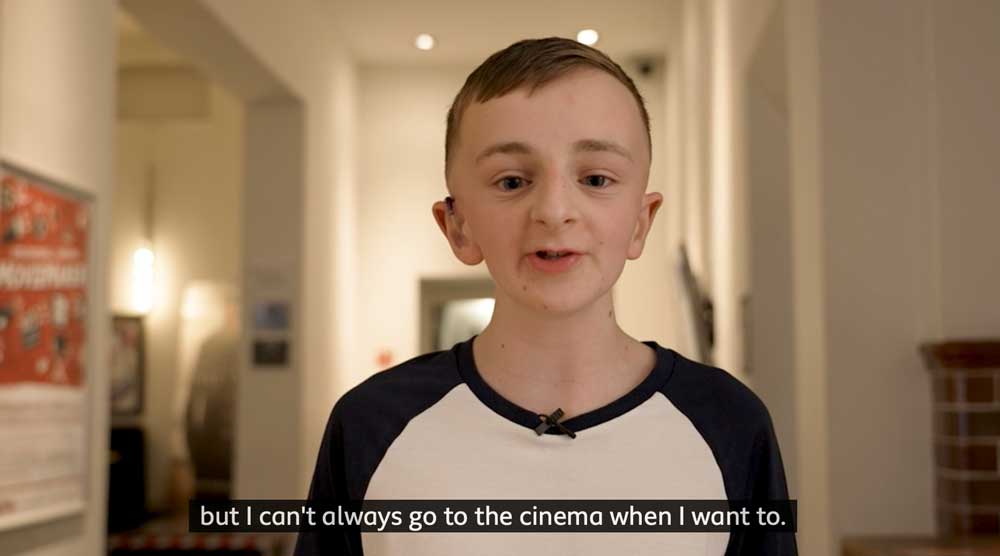
In 2023 the BBC Newsround programme sent Dan, a 13-year-old deaf film fan, to investigate cinema access while reporting on the superhero film “Black Adam”. Of the three major cinemas in Cardiff, Vue provided 30 screenings, only one of which was captioned. Cineworld screened the film 64 times, with two captioned shows. Odeon screened it 76 times, also with two captioned shows, neither at the weekend. BBC video report HERE

The 2022 release “Avatar: The Way of Water” had more than 1,000 captioned screenings across around 400 UK cinemas during its first week. Forty-six cinema companies took part. However, only four of those screenings took place on Friday or Saturday evenings, less than half a percent of all captioned screenings.
CODA, the 2022 Oscar winner for Best Picture, tells the story of a deaf family. The film itself was fully accessible, with captions included in every screening. Despite this, more than 90% of UK cinemas, including major chains such as Odeon, Vue and Cineworld, chose not to screen it. Many deaf audiences therefore had little or no opportunity to see the film in a cinema. Among the cinemas that did show it, several only scheduled daytime screenings.
The 2020 thriller A Quiet Place attracted strong interest from deaf audiences because one of the lead characters is deaf. During its opening week there were 365 captioned screenings across 277 cinemas. Although around one third of UK cinemas provided a captioned screening, most scheduled only a single showing. About half took place before 6pm, when many people are at work or school. Only three captioned screenings were scheduled on Friday or Saturday evenings.
In 2021 the film Eternals featured the first deaf superhero in a major Marvel release. Of the 572 UK cinemas showing the film in its first week, only about half provided captioned screenings, usually just one or two. Many were scheduled during daytime hours, and none were scheduled on Friday or Saturday evenings. (News article HERE)
Below is a report on captioned cinema from Jessica Kellgren-Fozard, a deaf YouTube creator from Brighton with more than a million followers.
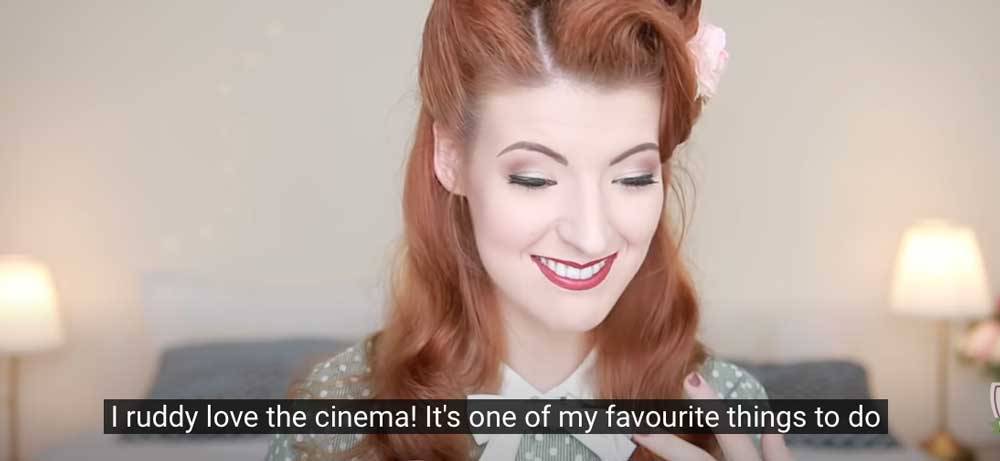
Guardian News report on subtitled/captioned cinema
HERE
NDCS report
HERE
Metro News report
HERE
iNews report
HERE
Den of Geek report
HERE
And check out this site with useful links and a video highlighting the views of influential deaf people that was shown to cinema industry leaders, in the hope it would change their view on subtitles. Progress update HERE
Could cinemas provide more opportunities to attend subtitled/captioned screenings?
Yes. In May 2022 cinemas temporarily doubled the number of captioned screenings for one week. The number of Friday and Saturday evening captioned screenings increased fivefold, with more than 100 shows nationwide compared with fewer than 20 the previous week. Several cinemas that had never previously scheduled a captioned screening also participated. This demonstrated that cinemas are capable of providing significantly more accessible screenings.
Deaf Awareness Week (2–8 May 2022): 3,428 captioned screenings across the UK and Ireland, covering 30 films. A total of 635 cinemas scheduled at least one captioned show, including 110 screenings on Friday or Saturday evenings (after 6pm).
Individual cinemas decide which films to screen with captions and when those screenings take place. In large chains such as Vue, Cineworld or Odeon, these decisions are often made by head office rather than local staff.
Some cinemas take a different approach and caption all films on one particular day each week. This means that every screening on that day is accessible to audiences with or without hearing loss.
For example, Moviehouse Coleraine in Northern Ireland captions every screening every Monday. The cinema typically offers around five films and about twenty screenings each Monday. Since February 2022 this has created more than 1,000 captioned screenings each year.
The cinema reports that while there may occasionally be complaints, audiences have generally become used to captioned Mondays and attendance has not suffered. Around 300 tickets are issued each week for captioned screenings, generating more than 15,000 admissions and over £100,000 in ticket sales annually.
Many cinemas report that once captioned screenings become a regular part of the schedule, audiences quickly accept them. Subtitles simply become another accessibility feature, similar to wheelchair spaces, ramps, accessible toilets or disabled parking bays.
The Depot cinema in Sussex, which has three screens, aims to caption all screenings on Mondays. It reports that attendance on “subtitle Mondays” is similar to attendance on other days, with some screenings selling out.
The Showroom cinema in Sheffield also runs “subtitle Mondays” and reports that audiences generally do not complain once they realise a screening includes subtitles or captions.
The Broadway cinema in Nottingham schedules dozens of subtitled or captioned screenings each week.
QUAD cinema in Derby also programmes many captioned screenings and reports that they do not reduce ticket sales. Hearing audiences who prefer not to watch captions can simply attend one of the many other screenings available.
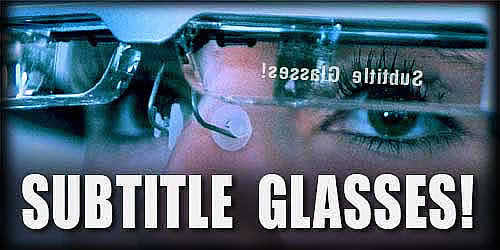
In addition to scheduling more captioned screenings, cinemas could expand access by introducing subtitle glasses. These devices allow captions to be viewed individually by the person wearing the glasses, meaning that any regular screening could potentially be accessible.
*This depends on the film distributor providing compatible subtitle tracks. Most major film releases already include them.
News: Subtitle Glasses at UK cinemas

Do cinemas screen many foreign-language subtitled films?
Yes. Across the UK and Ireland there are more than 800 cinemas and over 4,000 screens. Most cinemas regularly show foreign-language films with subtitles. Each week there are thousands of such screenings, including films in French, Polish, Indian languages, Chinese, Korean, Russian and many others.
Hundreds of these screenings take place on Friday and Saturday evenings, the most popular times for cinema audiences.
What's the law regarding cinema access?
The UK's Equality Act requires cinemas to make “reasonable adjustments” so that people with hearing loss can access their services. One example given in official guidance is: “A cinema chain ensures that subtitled or captioned performances of films are shown in all its branches.”
Details HERE
In 2022 the UK Cinema Association said: “While there remain some financial challenges around programming more of these screenings, cinemas remain fully committed to improving provision where possible.”
In New York City USA, a law introduced in May 2022 requires cinemas to provide captioned screenings for up to four showtimes per film each week, including popular cinema times such as Friday evenings and weekends.
The Mayor stated:
“In addition to moviegoers who are D/deaf and hard of hearing, subtitles and captions benefit almost everyone, especially people watching films in their non-native language and children and adults learning to read.”
Does it cost a cinema to welcome film fans with hearing loss?
No. Film distributors cover the cost of producing subtitle and caption tracks. Almost all films are supplied to cinemas with these tracks, which are also required later for television, streaming services and home entertainment releases.
For cinemas, scheduling a captioned screening of a popular film is unlikely to result in lost ticket sales. People who prefer not to watch captions can usually attend one of the many other screenings available. In most areas the same film is shown multiple times each day for several weeks.
Providing captioned screenings at peak times does not mean cinemas lose money. It simply means that a particular screening may generate slightly less revenue than a non-captioned show.
Smaller cinemas with only one or two screens may not be able to offer many captioned screenings for each film. However, it is generally expected that at least one accessible opportunity should be provided each week so that film fans with hearing loss can attend.
Cinemas do not expect accessibility features to generate profit. Facilities such as wheelchair spaces, ramps, accessible toilets, autism-friendly screenings, dementia-friendly screenings and captioned screenings are provided to ensure that everyone in the community can enjoy the cinema experience.
For example, cinemas provide spaces for wheelchair users even though these seats may not always be occupied. These spaces are included so that customers who use wheelchairs are able to attend.
In practice, many cinema seats remain empty each week, particularly during quieter periods. Whether a wheelchair space or an accessibility screening is filled on a particular day usually has little effect on overall box office revenue.
However, those spaces and screenings can make a significant difference to the individuals who need them, allowing them to participate fully in the cinema experience and wider community life.
The same principle applies to accessible screenings for audiences with autism, dementia or hearing loss. Although attendance may be smaller than regular screenings, the overall financial impact on a cinema is usually minimal because many seats would otherwise remain empty.
What matters most is that these screenings are scheduled at practical times, including evenings and weekends, so that people who work or attend school are able to attend.
Some cinemas with multiple screens have shown that it is possible to make all screenings accessible on a particular day each week by captioning every film on that day.
Captioned screenings are inclusive. They allow people with hearing loss to attend while still being enjoyable for audiences without hearing loss.
Attendance at captioned screenings is often modest because the number of people with hearing loss in any one area is relatively small, and they will not all choose the same film, day and time. Nevertheless, these screenings remain an important accessibility provision.
In July 2023 the release of “Barbie” helped create one of the busiest periods in recent UK cinema history. Several cinema chains reported record weekends. Curzon’s previous best week had been driven by the subtitled Korean film “Parasite”. Some cinemas also ran special events such as dog-friendly screenings.
WHAT CAN FILM FANS WITH HEARING LOSS DO TO IMPROVE THINGS?
If you are unhappy with a company’s service, one option is to let them know. Contact the cinemas you would like to attend and ask them to schedule captioned screenings of popular films at convenient times.
Encourage cinemas to provide an equal service and to welcome customers with hearing loss so that everyone can enjoy the cinema experience with family and friends.
You can also contact organisations that work to improve access for people with hearing loss, such as the National Deaf Children’s Society ( NDCS ) and the Royal National Institute for Deaf People ( RNID ). These charities can offer advice and support for campaigning for better accessibility.
Another option is to ask local cinemas to consider purchasing subtitle glasses. These devices allow captions to be viewed individually, meaning that regular screenings could potentially be accessible to people who require subtitles.
HOW CAN I FIND OUT WHAT'S SUBTITLED/CAPTIONED IN MY AREA?
The YourLocalCinema website makes it quick and easy to find English-language captioned screenings near you. Simply click
this link
to see screenings in your area.
You can save that page to your phone’s home screen or your browser’s bookmarks and check it regularly for the latest listings.
To make things even easier, let us know which cinemas or areas you would like listed and we can create a personal page just for you. Save the link and check it regularly for updates.
Email:
subtitles@yourlocalcinema.com
You can also get updates on TWITTER and subscribe to the free weekly email newsletter.
In 2025 YourLocalCinema promoted more than 100,000 English-language captioned screenings of over 400 films across more than 600 cinemas in the UK and Ireland.
WHY ARE ACCESSIBLE, INCLUSIVE CINEMA SCREENINGS IMPORTANT?
For film fans with hearing loss, accessible captioned screenings remove a major barrier, allowing them to enjoy films and participate in the shared cinema experience.
Accessible cinema has had a positive cultural impact. Each year in the UK hundreds of children are born with significant hearing loss, and more than ten million people experience some degree of hearing loss during their lives. As the population ages, more people benefit from captions.
Only a few decades ago, the only way many deaf audiences could follow a film at the cinema was by watching foreign-language movies with subtitles. Today, thanks to collaboration between the film industry, accessibility organisations and websites such as YourLocalCinema, most cinemas have the ability to provide captioned screenings.
WHAT PERCENTAGE OF UK CINEMA SCREENINGS ARE ACCESSIBLE?
Although cinemas are required to make “reasonable adjustments” so that people with hearing loss can attend, most English-language screenings are still not accessible.
Currently around 99% of English-language cinema screenings in the UK are not captioned. Of the small proportion that are captioned, many take place at inconvenient times, often mid-week during the daytime.
Only a very small number take place on Friday or Saturday evenings, which are the most popular cinema-going times.
As a result, many film fans with hearing loss who would like to watch popular films at the cinema simply do not have a convenient opportunity to attend.
Many cinemas provide only one or two English-language captioned screenings each week. To offer convenient access to most major film releases, a cinema would need to provide multiple captioned screenings across different days and times.
While it may not be practical for every cinema to schedule large numbers of captioned screenings each week, it is important that cinemas make a reasonable effort to provide accessible opportunities at sociable times.
In 2025 all of the top 100 English-language box office films were supplied to cinemas with caption tracks. During the year YourLocalCinema promoted more than 100,000 captioned screenings covering over 400 films.
The UK Cinema Association has noted that many operators want to provide more captioned screenings but are concerned that programming them at peak times may reduce box office revenue.
However, with effective scheduling and promotion, some captioned screenings at peak times can attract strong audiences. Over the years YourLocalCinema has worked with cinemas, festivals and outdoor screenings to bring together large audiences for well-attended captioned events.
For example, around 1,000 people attended a sold-out outdoor captioned screening of “The Greatest Showman” in Derby. Other captioned events, including a Saturday evening screening of “Mamma Mia”, also attracted strong attendance.
In London more than 1,000 people attended three captioned 3D screenings of the final Star Wars film. One screening at a cinema with more than 450 seats sold out completely. The screenings were clearly labelled as captioned on cinema websites, at the box office and in foyer signage.
Many people attending these screenings either specifically chose the captioned version or were not concerned about the presence of subtitles. Some attended with friends or family members who required captions.
For many cinema audiences, subtitles on screen are not a problem. Captioned screenings can therefore be inclusive events enjoyed by people with or without hearing loss.
HOW EASY IS IT FOR CINEMAS TO WELCOME FILM FANS WITH HEARING LOSS?
All cinemas can make their screenings accessible. Films can be shown with subtitles or captions at any time of day, allowing customers with hearing loss to enjoy the cinema experience with family and friends.
Films are delivered to cinemas either by hard drive or satellite. Most popular releases include a subtitle or caption track that can simply be switched on for specific screenings.
Some cinemas schedule just one captioned screening per week, while others offer several. A few cinemas caption every screening on a particular day each week.
Cinemas usually schedule captioned screenings in advance so that audiences know the screening will include captions. They generally avoid switching captions on at the last minute because the show may already have been advertised and sold as a non-captioned screening.
Note: for some 3D or IMAX versions, cinemas may need to request the caption track from the film’s distributor.
Although caption tracks are produced for almost all films in time for home entertainment releases, some smaller films or special events (such as live theatre or concert screenings) may not include captions in their cinema versions. In many cases the distributor could produce a caption track for the cinema release if required.
Many National Theatre Live broadcasts do include caption tracks, and cinemas often schedule accessible screenings.
Film trailers are also frequently available with subtitle or caption tracks. These tracks are often delivered automatically to cinemas, although occasionally cinemas may need to request them from the distributor.
Major film distributors regularly produce captioned versions of trailers for online promotion. These same caption tracks can easily be used to make cinema trailers accessible.
Examples
HERE
Although most cinemas can provide captions on screen, outdoor and drive-in cinemas rarely offer captioned screenings.
HOW MUCH DOES IT COST TO PRODUCE SUBTITLE/CAPTION TRACKS FOR FILMS?
Producing a subtitle or caption track for an average-length film typically costs less than £1,000. Creating the track usually takes one person around two days.
Most films receive caption tracks because streaming services and broadcasters such as Netflix, BBC iPlayer, Amazon and Apple generally require them before accepting a film for distribution.
Most major releases also include a narration track for audiences with sight loss, often called audio description. These tracks usually take longer to produce, typically two or three days, although artificial intelligence is beginning to reduce production time.
Each year UK film distributors invest significant sums producing both caption tracks and narration tracks so that films can be accessible in cinemas and later on television, streaming platforms and home media.
Around 1,000 films are released in cinemas each year and almost all include caption tracks. Prior to the Covid-19 pandemic, UK cinema attendance had reached some of its strongest levels in decades.
For example, during the summer of 2019 UK cinemas generated £474 million in box office revenue over four months. The Korean film “Parasite” became the highest-grossing subtitled foreign-language film in UK history, earning more than £11 million.
In 2018 UK cinemas recorded their highest admissions in fifty years, with 177 million tickets sold and £1.37 billion in box office revenue.
In 2022 more than 900 films were released in UK cinemas, generating almost £1 billion in ticket sales (£978 million). Around 135 of those films were major releases shown in 250 or more cinemas.
The biggest film that year was “Top Gun: Maverick”, which earned £83.6 million at the UK box office. The film had more than 2,700 captioned screenings across over 620 cinemas. Assuming an average attendance of around 15 people per screening and an average ticket price of £7.50, those captioned screenings alone generated an estimated £300,000 in ticket sales.
HOW CAN CINEMAS IMPROVE ATTENDANCE?
Feedback from thousands of film fans with hearing loss suggests that around 96% would attend the cinema more often if accessible screenings were offered at convenient times.
Increasing the number of captioned screenings during quieter off-peak periods may create more opportunities to attend without affecting cinema revenue. However, this alone does not meet the needs of most audiences with hearing loss.
Like everyone else, most people want to see the film they choose at a convenient time, which often means evenings or weekends.
Cinema subscription schemes that allow unlimited visits for a monthly fee can be difficult for film fans with hearing loss to justify when accessible screenings are very limited. In many cases a person may only have one opportunity each month to attend a captioned screening.
There are several practical ways cinemas could immediately increase access:
• schedule more captioned screenings of popular films at convenient times
• dedicate one screen to captioned films throughout the week
• caption all screenings on a particular day each week
Any of these approaches would make the cinema experience more inclusive while still allowing audiences without hearing loss to attend.
Another option is for cinemas to introduce subtitle glasses. These devices allow captions to be viewed individually by the person wearing them, meaning that most regular screenings could potentially be accessible.
ARE THERE INCLUSIVE / ADAPTIVE SOLUTIONS TO CINEMA ACCESS?
Inclusion can mean different things to different people. Some people with hearing loss prefer on-screen captions that everyone can see, while others may prefer adaptive technology that allows them to watch captions individually during a regular screening.
ARE THERE INCLUSIVE / ADAPTIVE SOLUTIONS TO CINEMA ACCESS?
Inclusion can mean different things to different people. Some people with hearing loss prefer on-screen captions that everyone can see, while others may prefer adaptive technology that allows them to watch captions individually during a regular screening.
Oct 2024:
UK Film Distributors' Association:
"We should all be striving to improve accessibility ... We know that there is a general increase in audiences choosing to watch subtitled/captioned content either on mobile devices or at home ... 61 percent of 18–24-year-olds and 13 percent of 50–64-year-olds , equating to over a quarter of the population – suggesting that subtitled/captioned shows are now more likely to be accepted by general audiences, not just the deaf community"
Mar 2024:
UK Cinema Association:
"Despite its strong reputation for delivering accessible cinema, the UK cinema sector faces a particular challenge around the provision of open [on-screen] captioned screenings for deaf and hard of hearing customers, general experience being that the wider audience is resistant to such screenings, and so their programming remains comparatively limited given its impact on admissions"
"Developed with funding support from the UK Cinema Association, WatchWord provides a personalised solution, delivering subtitles/captions through a pair of ‘smart’ glasses. Built For Good Technology [WatchWord developers] plans for a nationwide roll-out of the solution"
"... the experience of many cinema operators is that the wider audience remains in general resistant to captioned screenings, with a resultant impact on admissions and box office revenues ... many major film releases are now promoted through accompanying captioned film trailers, these being played in the pre-show before an open captioned film performance"
"... monitoring the utilisation of new and emerging technologies to deliver more reliable and more importantly audience-friendly solutions for delivering accessible cinema. The primary challenge here is the provision and delivery of descriptive subtitles or ‘closed captioned’ screenings, something which would make the big screen experience more accessible not just for deaf and hard of hearing customers, but also for their family and friends, who often as a consequence find their own cinema-going opportunities limited..."
"... Responding to increasing interest ... a structured exercise to develop a viable and market ready smart glassed-based ‘closed captions’ solution, where only the person who requires the captions will see them ... 2023 was the year this work really hit its stride, with Built For Good Technology undertaking a number of rounds of in-cinema testing which helped fine-tune the solution in operational terms as well as improving the user experience ... a ‘live’ two-month trial of the solution – now called WatchWord – at a number of cinemas in order to gather further operational feedback, with the hope that the solution would then be ready for roll-out in 2024"
Customer review
HERE
Details
HERE
Jun 2024: ScreenDaily reported that younger audiences appear increasingly comfortable with subtitles. “…young people often enjoy subtitles, whether that’s subtitles from a foreign-language film … Instagram … TikTok” https://tinyurl.com/2024Subtitles
May 2024: Australia: Deaf people taking cinemas to court over lack of subtitled/captioned screenings .
May 2024: BBC News: Sheffield study calls for 'better' film subtitles/captions
Jan 2024: Subtitle Glasses trial at UK cinemas!
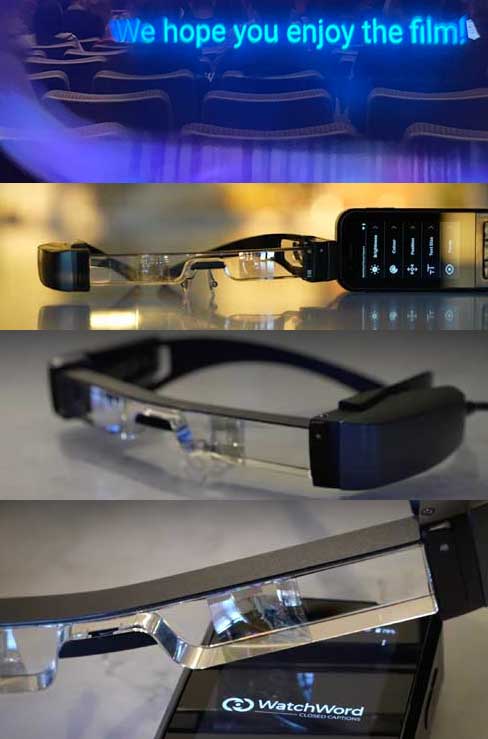
More info
•
Video
•
Spec sheet PDF
Apr 2023: YouTube video of new AR glasses
Aug 2022: New AR glasses
Apr 2022 : Built For Good Technology working with UKCA to investigate subtitles/captions glasses.
May 2022: RNID statement : subtitled/captioned screenings in cinemas – the only way to increase access now.
RNID's open letter to the UK Cinema Association (UKCA) – do more to make cinemas inclusive for deaf people now.
We [RNID] are disappointed with the UK Cinema Association’s efforts to improve access to cinemas for those who are deaf or have hearing loss. The only way that deaf people and those with hearing loss can currently access cinemas is through more subtitled/captioned screenings.
Shockingly, BBC’s Rip Off Britain (series 14, episode 3, 4 May 2022) highlighted that the number of captioned cinema screenings is incredibly low. They found that across four cities in a week, Odeon only captioned 17 of 920 screenings (1.8%), Cineworld captioned 12 of 1070 screenings (1.1%) and Vue captioned 8 of 819 screenings (0.98%).
The UKCA’s temporary increase of captioned screenings during Deaf Awareness Week was not enough to improve access, and data from the National Deaf Children’s Society (NDCS) showed that a quarter of UK cinemas failed to show any subtitled/captioned screenings during Deaf Awareness Week. This is not good enough.
Previously, we have partnered with the UKCA on several initiatives, including their Technology Challenge which aims to find technology-based solutions to improve access to cinemas for people who are deaf or have hearing loss. But there has been a failure to prioritise pushing for subtitled/captioned screenings, and we have seen no improvement in the accessibility of cinemas, or to the lives of the 12 million people in the UK who are deaf or have hearing loss and the 7.1 million who have tinnitus.
We believe that increasing subtitled/captioned screenings is the best way to improve access and will have a bigger impact for our communities more quickly. We are therefore suspending direct engagement with UKCA on their Disability Working Group but remain open to working with cinemas directly to increase subtitled/captioned screenings, and the UKCA if they are able to show that they are committed to making cinemas accessible for everyone, now.
RNID's open letter to UKCA:
Chief Executive, UK Cinema Association
I’m writing to let you know that, given the lack of meaningful progress in our work together, we have decided that we will no longer be an active part of your work on accessible cinemas.
As an organisation, we are disappointed with the lack of engagement with us over the last three years, and the lack of real action taken to make cinemas accessible for people with hearing loss. At times, commitment to this work has felt shallow and tokenistic, and we believe we can make more progress for our communities by working directly with cinemas.
Deaf Awareness Week
The UKCA’s decision to increase the number of subtitled/captioned screenings during Deaf Awareness Week – but then drop back to original numbers after the week is over – is one example of that tokenistic approach. In fact, looking at the accessible screenings website, it appears that subtitled/captioned screenings during this week are in fact still incredibly rare.
Ahead of Deaf Awareness Week, we were clear that a temporary uplift in subtitled/captioned showings is simply not good enough and would not be received well by deaf people and people with hearing loss. The negative response from our partners and communities to this activity is not a surprise, and I sincerely hope that the UKCA are listening and will take note of the reaction.
Technology Challenge
RNID had been a partner in the UKCA’s Tech Challenge, since 2018 but the lack of updates and progress to the panel in the last two years led us to decide to step away from the project, but we were clear we remained happy to engage with you on promotion of subtitles in cinemas which we feel could be used to improve access to cinemas for deaf people now.
The UKCA made a comment last week saying that subtitles and technological solutions were not “an either/ or” and with this in mind, we are keen to know why there has been such slow progress on the delivery of screenings with subtitles across cinemas in the UK, and why the UKCA has not engaged with concerns about the lack of provision of subtitled/captioned screenings in good faith on behalf of its members. Even under the new timeline of delivery for the Technology Challenge, deaf people and people with hearing loss will not be able to benefit from this new technology in the short term and the barriers to accessing cinemas will remain. The lack of forward movement within this group led us, as you know, to withdraw our participation in it back in Jan, as we believe focusing efforts on increasing and promoting subtitled/captioned screenings will have a greater impact for our communities.
Subtitle provision in cinemas
As highlighted on the BBC’s Rip Off Britain last week, across four cities, Odeon had 920 screenings, 17 of which were subtitled/captioned (1.8%). Cineworld had 1070 screenings, 12 subtitled/captioned (1.1%). Vue had 819 screenings, 8 subtitled/captioned (0.98%). These figures fail to capture the timings for accessible screenings, which are typically limited to off-peak times. We would suggest that not only is this bad for accessibility, but it doesn’t make good business sense either. 1 in 5 adults in the UK are deaf or have some form of hearing loss. That’s a huge market to ignore. The success of international films such as Parasite and the film CODA which had embedded subtitles, show that audiences will turn up to screenings with subtitles.
We know that being able to participate in cultural events like cinema releases is hugely important to people who are deaf or have hearing loss, which is why we’re keen to see accessibility prioritised sooner rather than later. Of course, at RNID our door is open to any cinemas looking to make screenings accessible but for us to re-engage with the UKCA we would need you to demonstrate that you are serious about improving accessibility and are prepared to engage meaningfully with us and the community we serve. If you would like to discuss this further, you can contact our Inclusion Policy Advisor.
Kind regards,
Teri Devine
RNID Associate Director for Inclusion
May 2022: UK Cinema Association:
"Trials of the glasses were necessarily paused as a result of the pandemic, during which time the team working on them left the NT and established themselves as Built for Good Technology. We are now working with them again with a view to a further trial later in the year"
UK Cinema Association: "SUBTITLING TECHNOLOGY CHALLENGE FUND. The STC fund is aimed at finding a smart solution to in-cinema subtitling for those with hearing loss. The ongoing pandemic related disruption of the past two years has meant that this UKCA project had to be placed on temporary hold. However, in late 2021 the Association was able to pick this work strand up again and there is now a clear direction of travel to further develop a smart glasses solution for those who would benefit from in-cinema subtitling"
Previously:
UKCA recommends to its members that cinemas should:
'endeavour to show more subtitled/captioned films more frequently'.
It said:
'
The positive response in recent years from audiences to accessible screenings has seen more and more UK cinemas look to offer these screenings ...
there is still a need for more cinemas to participate to ensure there are more opportunities to enjoy the big screen experience"
It said:
"Prior to the pandemic, the [cinema] sector had seen a steady growth in [English language] subtitled/captioned screenings ... there is clearly more to do in this area ... exploring opportunities to deliver more personalised solutions ... a good deal of optimism and a clear way forward to developing a workable smart [subtitles/captions] glasses solution"
"closely following a number of app-based personalised solutions that deliver audio description [for film fans with sight loss] through a person’s own smartphone or similar device ... Despite some initial progress, very little of substance has materialised from these approaches to meet the needs of customers while at the same time offering the level of content security that the major US studios demand for their titles. With that in mind it is hoped that [in 2022] pick up previous discussions about possibly creating an industry-wide set of technological standards for such apps"
@Cinema_UK "We are still focussed on developing an accessible ‘closed subtitles/captions’ solution for audiences. The lockdown – and changes at partner organisations – delayed pilots of the most promising ideas, but we are now picking this up again, looking also at technology which has since emerged ... In developing new solutions, we will continue to work with an advisory group including not just @RNID and @NDCS_UK but also a number of deaf and hard of hearing cinema-goers"
"The Technology Challenge Fund was established to explore new ways of delivering ‘closed subtitles/captions’ only to those who needed them, but potentially for all cinema screenings, massively widening the range of films available to deaf customers, and their ability to enjoy the big screen experience with friends and family.
'Having towards the end of 2019 identified two preferred options for its second (and final) phase of funding – both adapted eyewear solutions, developed by Screen Language and the National Theatre respectively – the Association spent the early months of this year supporting the undertaking of further feasibility tests on the two solutions. At that point, a decision was made not to pursue the Screen Language option on the basis that further development would require a great deal of additional work and funding, with little evidence that a solution feasible in a cinema environment could be delivered. That said, the Association will remain in contact with the company as they develop their concept with separate funding.
'The sole focus of attention going forward therefore became the specially-adapted ‘smart subtitles/captions’ glasses developed by the National Theatre and already shown to be of proven value in the theatre environment. With successful testing and configuration of the system to the cinema environment achieved, in Jan the BFI London Short Film Festival hosted the first UK pilot of the glasses for deaf and hard of hearing audiences. In total, 30 devices were made available for audiences to book and use across a significant number of the festival’s performances. A hugely exciting milestone for the Fund, this exercise provided much greater understanding of the operational practicalities of supporting these devices in cinemas, as well as valuable feedback from users. As a result of the latter in particular, issues around the comfort and weight of the glasses were identified.
'While the lockdown of the UK sector arising from COVID-19 has unfortunately put a stop to further development and testing, the plan remans as soon as possible to begin that process again, and to begin a discussion with the glasses manufacturer Epson on the potential there might be to simplify the current hardware, making it both more comfortable and affordable."
Smartphones can also be used as personal accessibility tools through various free apps. Some cinemas allow these apps to be used (with screens dimmed and phones on silent). However, there is currently no official system to synchronise or stream subtitle/caption tracks from a cinema server to a phone. In most cases the user must hold the phone in position for the duration of the film, ideally aligned with the bottom of the cinema screen.
A reliable personal access solution could also reduce some of the scheduling or operational issues that occasionally occur with captioned screenings. If subtitles/captions were always active but only visible through a personal device, the risk of staff forgetting to enable them for a scheduled show would be reduced.
Such mistakes are rare — only a handful of the roughly 1,600 weekly English-language captioned screenings encounter problems. However, when it does happen the consequences can be significant. Customers who rely on captions often have only one opportunity to see a film on the big screen and may have travelled considerable distances to attend.
Personal subtitle/caption solutions could potentially reach a very wide audience. With built-in language options, captions could also be offered in multiple languages commonly spoken in the UK.
Feedback received by YourLocalCinema:
"This is not a complaint. Thought you might like to know about our experience attending a subtitled/captioned film in Salisbury. Upon arriving, after travelling 21 miles from home, there was a notice on the door stating 'Sorry, Theory of Everything is sold out'. Unfortunately for us, 93 Spanish language students had booked."
A personal “always-on” accessibility solution could eventually bring cinema access closer to the level already available at home through television and streaming services. While many deaf audiences still prefer on-screen captions, adaptive technology could make every screening accessible — across all cinemas, screens, films and showtimes.
In time, accessible cinema could become as routine as other accessibility features such as audible traffic crossings, audio announcements on public transport, ramps, lifts, wheelchair spaces and accessible parking.
NEWS:
US cinemas follow UK cinemas lead on subtitling/captioning:
https://www.washingtonpost.com
WHAT IS THE UK CINEMA INDUSTRY DOING TO HELP IMPROVE ACCESS?
The UK cinema industry says it is determined to help ensure that people with hearing loss can enjoy the cinema experience and continually investigates developments in the area of accessible cinema. A percentage of income from the industry's ‘Carer goes free’ discount card scheme, where 100,000+ people pay £6 annually, is allocated to be spent on cinema access schemes.
The UK Cinema Association's 2018 Annual Report stated
'Subtitling ... general unwillingness of the wider audience to embrace such screenings – and the resultant reluctance of cinema operators therefore to schedule them at peak times – has resulted in fewer subtitled/captioned screenings, and less at peak times, than many deaf and hard of hearing customers would like, something which became the subject of increasing sociable media comment during the year, culminating in at least two high profile petitions demanding that cinemas increase their provision in this area ... sat down with those behind these petitions, both to hear their views and explore how the industry might if possible respond"
£75,000 CINEMA SUBTITLING CHALLENGE FUND.
"The UK Cinema Association (UKCA) and Action On Hearing Loss (RNID) are excited to launch this new challenge fund ... the development of a solution that will allow people with hearing loss to have a more inclusive cinema experience ... help to find a suitable commercial partner to develop and create a market-ready product ... cinemas committed to trialing any viable solutions".
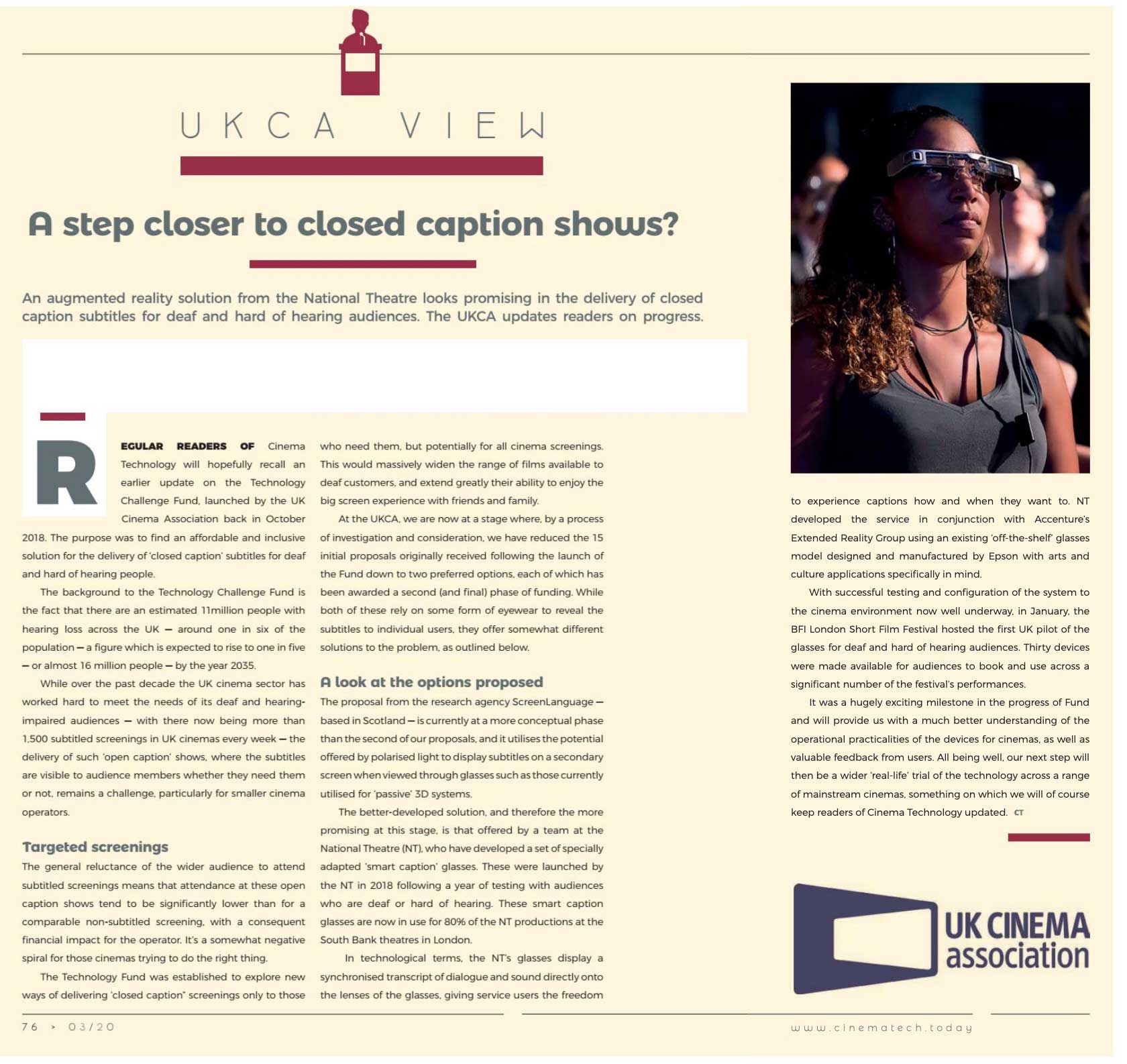
Mar 2020 article on the fund
HERE
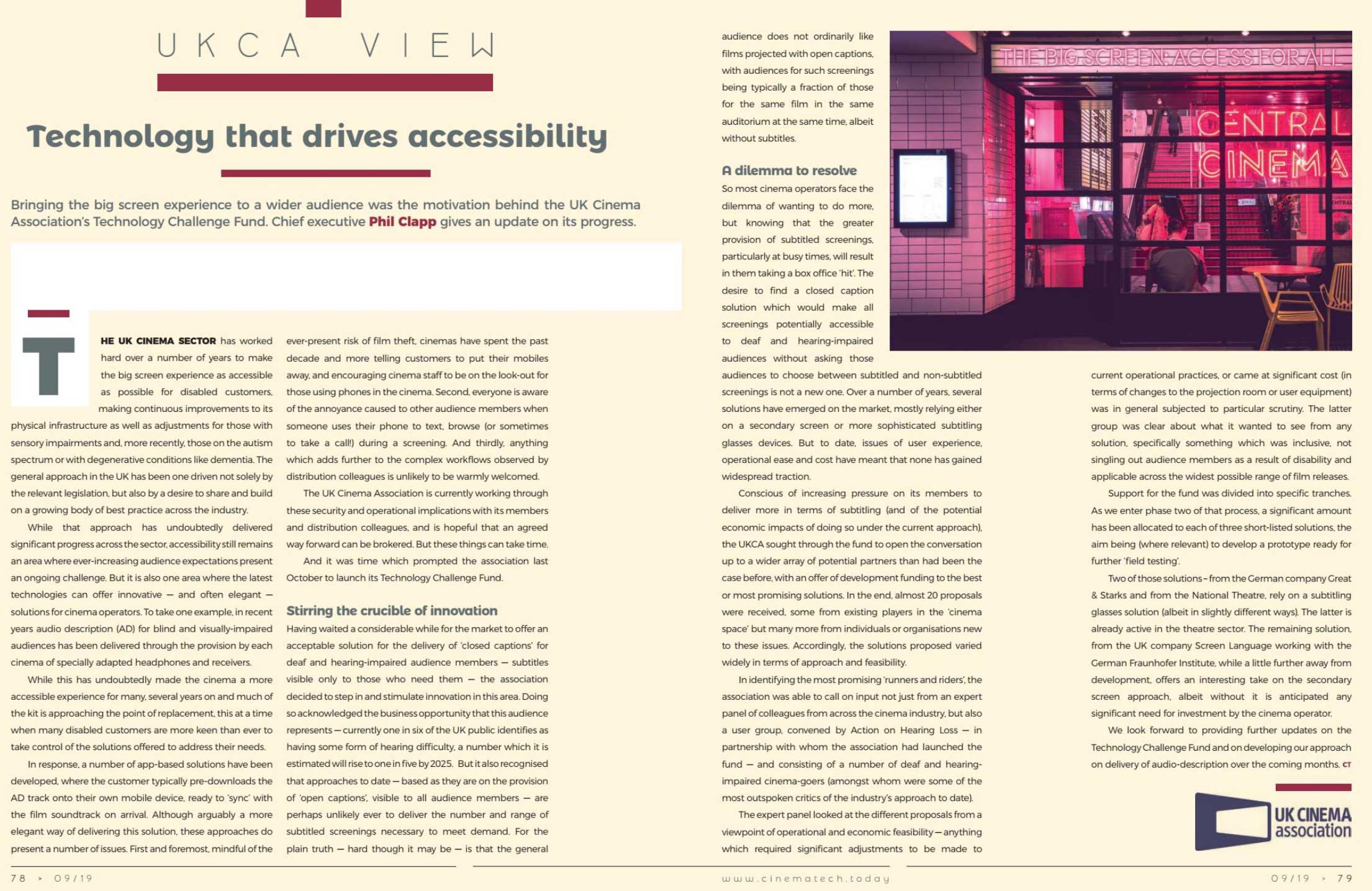
Sep 2019 UKCA article on the fund
HERE
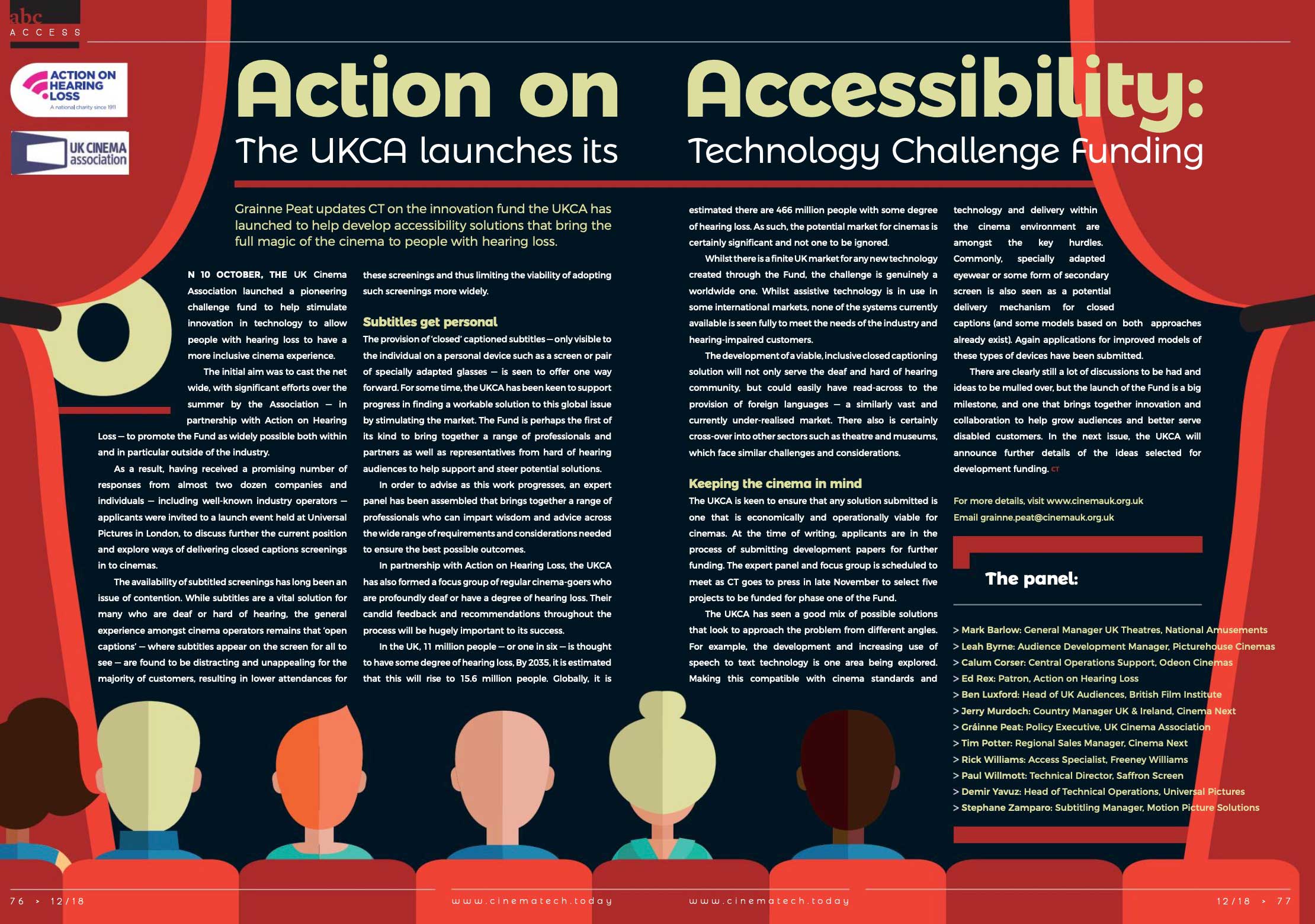
Dec 2018 UKCA article on the fund
HERE
Jun 2018 UKCA article on the fund
HERE
&
HERE
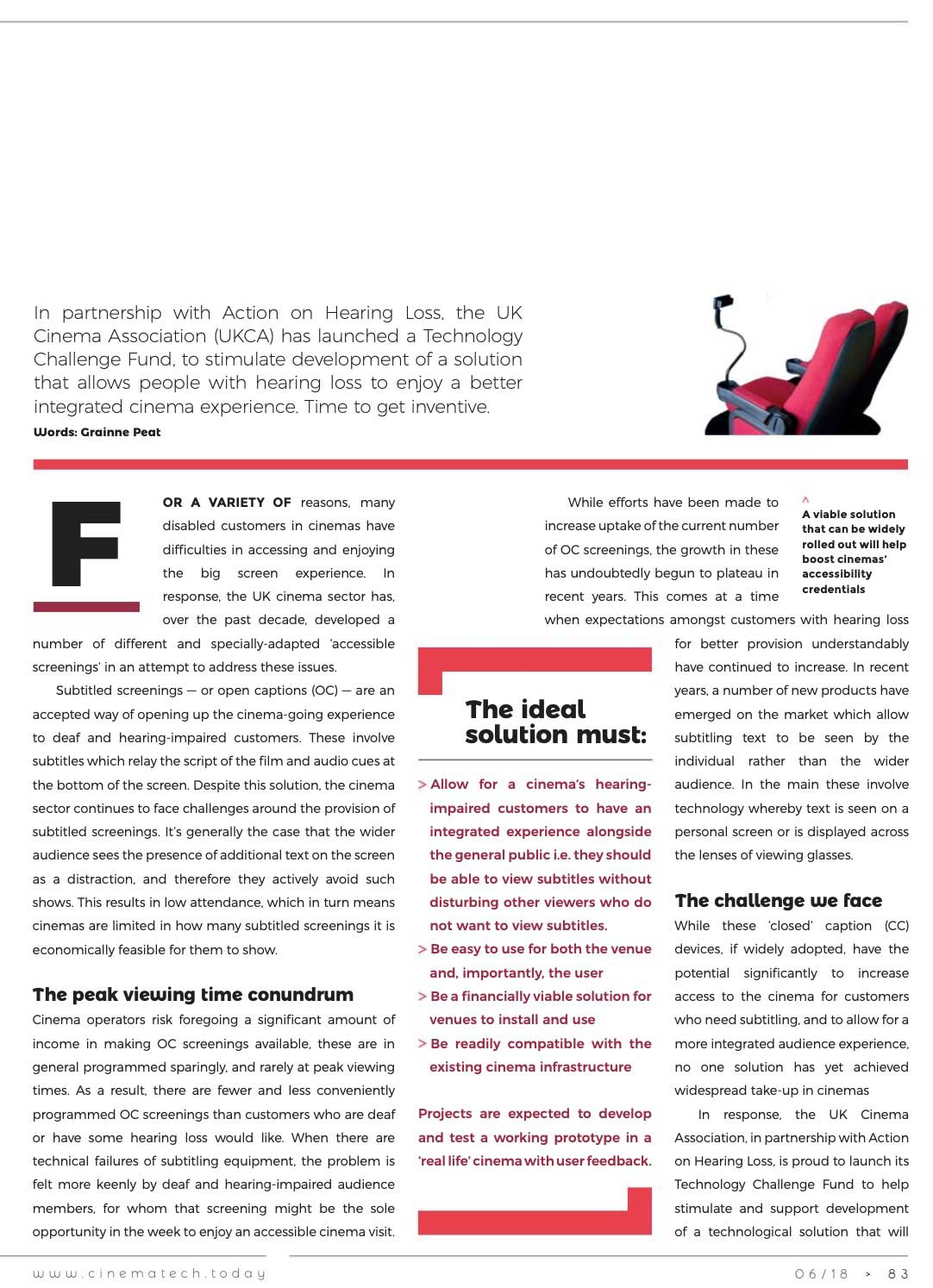
Mar 2017 UKCA article on cinema access solutions
HERE
&
HERE
&
HERE
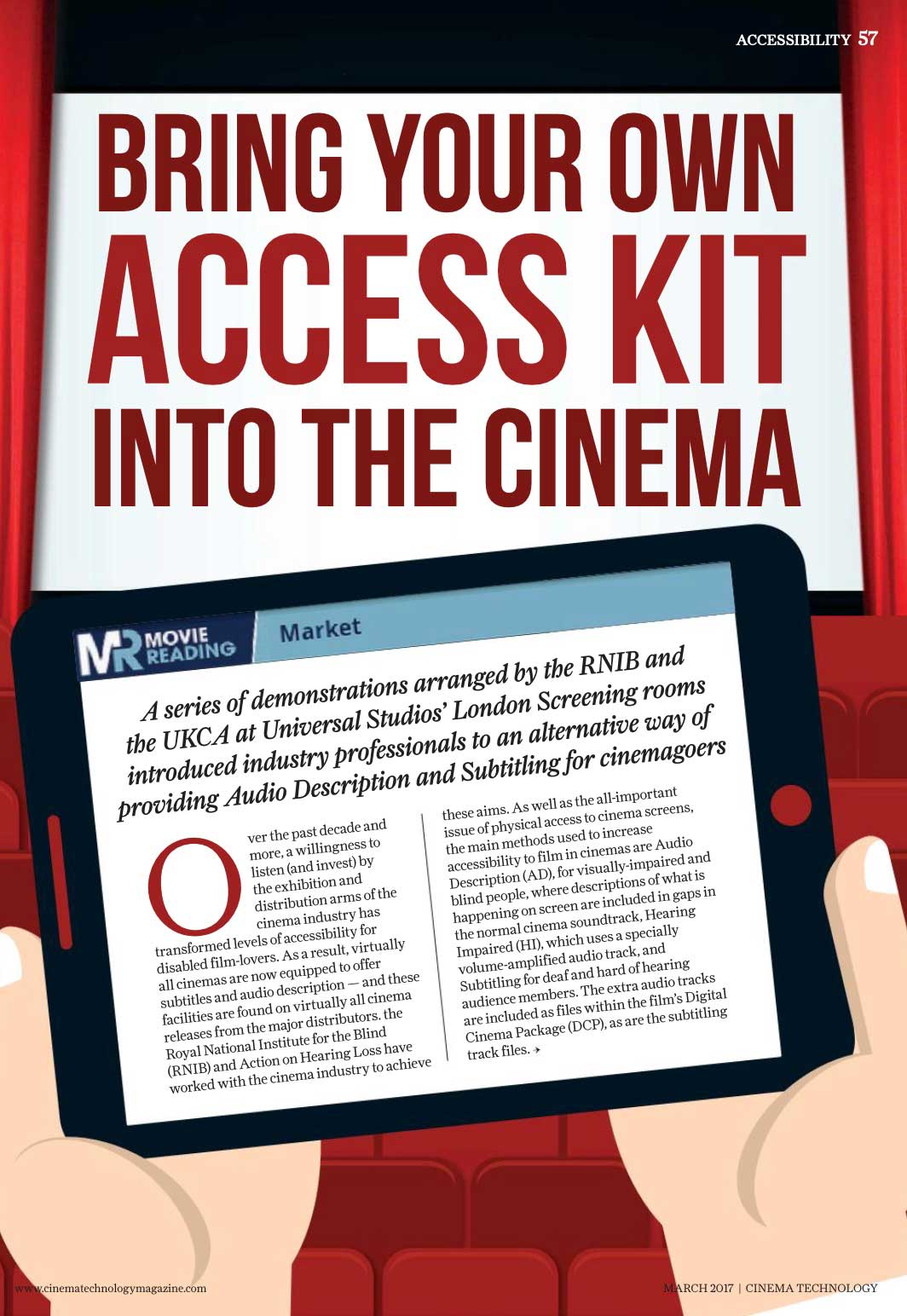
CAN CINEMA TRAILERS BE ACCESSIBLE TOO?
Many film trailers are also provided to cinemas with a subtitles/captions track, and delivered to cinemas automatically. If not, cinemas can ask the films' distributor for the track. Cinemas can then, if they want to, set this track to 'on' at subtitled/captioned screenings.
If the subtitles/captions track was switched on for trailers shown at scheduled subtitled/captioned screenings, not only would customers with hearing loss receive an equal service, they could also relax before the show, in the knowledge that the subtitles/captions are switched on.
Thanks to Paramount, who created and distribute the film, for 'Mission Impossible: The Final Reckoning' (May 2025), subtitled/captioned adverts from 29 companies were made available to cinemas to screen before the film. Digital Cinema Media (DCM) produces subtitles/captions tracks for cinemas for free.
Every week somewhere in the UK a scheduled subtitled/captioned screening begins without the captions appearing on screen. When this happens, audience members who rely on captions usually notice immediately when dialogue starts but no text appears.
This often leads to a quick search for a member of staff to ask them to “switch the subtitles/captions on”. In many cases the film is restarted and the issue is resolved. However, occasionally the screening continues without captions, leaving customers disappointed after making the journey to the cinema and missing their only opportunity to see the film on the big screen.
Showing trailers with subtitles/captions before a captioned film could help avoid this uncertainty. If the trailer is captioned, audiences can be confident that the film will also be captioned. If not, customers would have time to alert a member of staff before the main feature begins.
How does YourLocalCinema differ from other listings sites?
YourLocalCinema is an audience development agency financially supported by Film Distributors' Association (FDA) / UK film distributors and the British Film Institute (BFI).
YourLocalCinema began as a grassroots, social outreach movement to enable deaf children to socialise at cinemas with their families and friends. It was initially funded by, amongst others, UK cinemas and the RNID & NDCS hearing loss charities.
Co-founded and co-managed by a profoundly deaf film fan, YourLocalCinema can relate to issues deaf cinema audiences face. It ensures that film fans with hearing loss can directly engage and correspond in a variety of welcoming, valued, deaf-friendly correspondence formats that include text messaging, live chat, email, Facebook, WhatsApp, very active Twitter, and, if necessary, sign-language via Zoom.
YourLocalCinema provides a YouTube channel with the latest film trailers in an accessible, subtitled/captioned format, and a searchable website DEDICATED to clear listings of English-language subtitled/captioned screenings. It also offers a unique, personalised link that when saved to a smartphone's home screen, requires just ONE CLICK to view details of ALL subtitled/captioned screenings nearby.
YourLocalCinema has two decades of experience in developing audiences for subtitled/captioned cinema and has never failed to deliver its weekly, targeted direct email/social media/mobile newsletter that promotes English-language subtitled/captioned screenings DIRECT to its unique database of tens of thousands of film fans with hearing loss.
The YourLocalCinema.com website serves more than a million visits annually, helping to drive thousands of customers to hundreds of cinemas each week.
In 2025, YourLocalCinema promoted 100,000+ subtitled/captioned English-language screenings of 400+ films, across almost all UK/IRE cinemas. Screenings are promoted DIRECT to the target audience of thousands of film fans with hearing loss. More than a million customers attend subtitled/captioned screenings each year. Attendance has tripled since 2010.
YourLocalCinema provides valued customer service and engagement, which has ensured the loyalty of a large and appreciative customer base, which in turn has driven revenue to distributors & cinemas. This virtuous circle has reinforced itself for two decades.
For people that require subtitles/captions for their film enjoyment, there’s often only one chance to catch a film at the cinema. When it comes to accessible listings, accuracy is the most important element. The YourLocalCinema.com website is updated three times daily. Listings are checked for accuracy. Many cinemas are contacted weekly to verify any discrepancies. YourLocalCinema is efficient, flexible, and can adapt to short-notice changes in cinema schedules swiftly and seamlessly. Staff are available around cinema's opening times, including evenings and weekends, to amend any errors/changes in cinemas' schedules.
YourLocalCinema produces regular progress reports on how cinemas are doing regarding accessible films/screenings/days/am/pm times and regularly provides data to be used in press releases, news reports and social media comment.
YourLocalCinema has many satisfied customers! BFI survey feedback: More people clicked 5 out of 5 stars than any other figure.
Accessible, inclusive subtitled/captioned screenings enable film fans with hearing loss to ENJOY rather than endure cinema. For a few hours, the disabling barrier is removed. They provide social benefits such as equality, inclusion and community integration.
Accessible, inclusive screenings benefit people of all ages. Each year in the UK, hundreds of children are born with significant hearing loss. It's estimated that more than ten million, including thousands of young people, have hearing loss. Our society is ageing, and with ageing, loss of some hearing is inevitable. Access to film - via subtitles/captions - is something that we may all appreciate, eventually.
YourLocalCinema has two decades of experience in developing audiences for subtitled/captioned cinema. It has built much of the audience for subtitled/captioned screenings.
YourLocalCinema sends regular reminders to many inaccessible cinemas - to please be accessible.
YourLocalCinema has a long legacy as a trusted source of information. A household name amongst the target audience - children, young people and adults with hearing loss who enjoy cinema. Each week, YourLocalCinema reaches tens of thousands of this audience, who then use the site to plan their cinema-going.
YourLocalCinema helped persuaded UK film distributors to ensure that cinema trailers were subtitled/captioned. The eventual aim is for UK film distributors to routinely produce and provide trailer subtitles/captions tracks to cinemas, and then for cinemas to screen subtitled/captioned trailers at scheduled subtitled/captioned screenings.
YourLocalCinema continues to create awareness of cinema access/inclusion issues by engaging as many social media users as possible. YourLocalCinema has built solid, lasting relationships with many bloggers, reporters, and social media advocates/influencers in the fields of access/inclusion/hearing loss. New relationships are constantly fostered through regular activity on social media channels, creating informative, relevant, content that can be easily shared through social media and email.
YourLocalCinema produces detailed and engaging research/articles/charts/data that often provides the audience/film industry/BFI with new insight into the important issues of cinema access/inclusion.
YourLocalCinema provided 10+ years of data/reports the UK film industry’s 'Disability Working Group', an industry think tank that includes charities representing people with disabilities, film companies, and cinema companies.
None listed. Ask the cinema to schedule more accessible screenings!
YourLocalCinema has been in business/online for a long time - more than two decades - and has built a positive reputation amongst its users, who trust the accurate and reliable information presented on the YLC site.
YourLocalCinema regularly provides data to be used in press releases, news reports, presentations, speeches and social media comment. It has provided source data for, amongst others, RNID, NDCS, BDA, Sky/C4/C5 news, The Times, The Guardian, Daily Mail, BBC TV, iNews, ICO Screening Days, ScreenTrade mag, Den of Geek, FDA, BFI, CinemaTech, and many researchers/social media influencers in the access field.
YourLocalCinema has, for more than a decade, collaborated with INTO Film to ensure that its annual film festival is inclusive to audiences with hearing loss. Information on accessible cinema is distributed to every primary and secondary school in the UK, which creates mass awareness of cinema access & inclusion amongst hundreds of thousands of young people nationwide.
YourLocalCinema keeps the UK film industry informed of tech progress. In 2010, YourLocalCinema suggested to the UK cinema industry that it should run a news-worthy competition for companies/tech-minded individuals to come up with consumer-friendly ‘cinema subtitles/captions’ ideas, then support research & development to help bring a suitable product to market. (In 2018 the industry did just that).
YourLocalCinema has helped the BFI, UKCA and others to round up attendees and focus group participants for full-house film industry events to address both the fiscal and technical challenges of cinema access 'adaptive aids', such as subtitles/captions glasses, separate displays and smartphones.
YourLocalCinema has many 'satisfied customers' - Each year BFI requests a YourLocalCinema.com user survey. In 2022 1,000 cinema-goers were surveyed. Feedback: Most users reported that they were very satisfied with YourLocalCinema's service. More people clicked 5 out of 5 than any other figure.
YourLocalCinema helps cinemas make money. The Independent Cinema Office report 'Developing Deaf Audiences in Your Cinema' states YourLocalCinema as the most commonly-cited source of information for deaf audiences to find out about subtitled/captioned screenings. A number of respondents cited YourLocalCinema.com as the most reliable resource for finding subtitled/captioned screenings rather than the websites of cinemas.
YourLocalCinema provides regular data on subtitled/captioned screenings data for the NDCS, which is used to generate media coverage
YourLocalCinema provides this FAQ page, informing users about how accessible cinema works, the service that they can expect from cinemas, and their rights regarding access, equality and inclusion.
YourLocalCinema provides good customer service and engagement, which has ensured the loyalty of a large and appreciative customer base, which in turn has driven revenue to distributors & cinemas. This virtuous circle has reinforced itself for two decades.
WHAT HAS THE BFI RECOMMENDED TO THE UK FILM INDUSTRY, REGARDING ACCESS/INCLUSION?
The BFI is a UK public body which awards money raised from the sale of National Lottery tickets to film-related projects. Last year it received around £97m from the Lottery and awarded £48 million to film-related projects. Since 2011 it has awarded more than £220 million. It has supported YourLocalCinema since 2004. The BFI has recommended the UK cinema industry improve access to film fans with hearing or sight loss.
Its 2002 report stated:
'Evidence from the USA suggests that legislation and the market alone will not deliver the kind of widespread access which cinema patrons with sensory loss need and want ... things required to make it happen: A level of investment which creates critical mass in the market place ... Open [on-screen] subtitles/captions means a limited number of screenings. What is important is that such screenings are regular and well publicised'. It recommended: 'The reaction of hearing audiences to open subtitles/captions should be formally tested with a view to determining an ‘acceptable level’ of open screenings. Continue to monitor customer feedback ... A national promotion/publicity drive to encourage people with sensory impairments to visit the cinema ... The website resource YourLocalCinema needs to be put on a firmer financial footing'
The recommendations above helped create the UK's first 'Cinema Access Scheme'. In 2002, a few dozen cinemas began to test and eventually trialed the DTS Cinema Subtitling Solution, which was eventually adopted by hundreds of UK cinemas. Many cinemas adopted a similar product (Dolby ScreenTalk). Thanks to the rise of digital cinema, those 35mm film/disc-based solutions are now obsolete.
The success of the Cinema Access Scheme, which was mostly England-based, helped to introduce similar schemes to Northern Ireland, Scotland and Wales. (In 2004 YourLocalCinema became the official 'marketing arm' for all of those schemes, growing the audience for accessible cinema along the way).
YourLocalCinema has since helped research and produce many industry reports. The BFI 'Study of cinema access and film consumption for audiences with sensory impairments' report stated:
'83% of people with hearing loss said they would attend cinema regularly if a nearby cinema had subtitled/captioned screenings at convenient times'. Recommendations: 'Increase choice of films, showtimes, number of films ... Establish industry standards ... Promote efficient advertising'
The UKFC/BFI 'Diversity Report': 'ensure that equality and diversity commitments are fully integrated ... enable all groups within our society to participate in and enjoy film culture .. ensure full and equal access to film for people with disabilities, particularly as audiences'
The BFI 'Disability Equality Scheme': 'access, inclusion and diversity issues to become mainstreamed ... continue to fund YourLocalCinema, based on its success and evaluation reports with high levels of satisfaction from disabled users'
The 'Peer Review of the UK Film Council', commissioned by the DCMS: 'improve access and inclusion for all ... continued support of the YourLocalCinema service'
BFI 'Policy and funding priorities for the next three years' consultation: Around 1,000 responses received, including a 'strong showing of responses from deaf and blind people and their representatives, calling for continued support for accessible screenings in cinemas'
An ICO report funded by the BFI’s Film Audience Network: ‘more could be done for people who are affected by deafness ... create real change so that the cinema can be the same transformative experience as it is for hearing patrons’
The BFI ‘2022’ report: ‘BFI is committed to ensuring that the cinema experience is open to all, especially to disabled audiences ... we have placed diversity and inclusion at the heart of our objectives ... clearly a moral imperative for society generally ... work with partners to ensure that all audiences have the opportunity to enjoy film ... . Film has the power to engage all sections of society ... Inequality in access to culture is bad for business and bad for society'
In 2013, the UK cinema industry tested three 'personal' subtitles/captions solutions (Sony glasses and Dolby & USL displays). The product considered most suitable for the industry (glasses), was also the most expensive (at around £1,000 per unit). In late 2014, Sony reduced costs by around 25%, and the UKCA began to consider plans for a controlled ‘real life’ pilot. But in 2015, after four years development and UK sales efforts, Sony decided to withdraw the product from UK/Euro markets. Its press releases stated: ‘Sony recognises inclusion as essential, but is also aware of the need for a more robust and commercially viable solution for our customer’s needs.’
Accurate, targeted listings of accessible screenings should be an integral part of any subtitles/captions solution company's sales strategy. Market the BENEFITS of the product, rather than the product itself, directly to the target audience - film fans with hearing loss.
WHAT CAN BE DONE TO ENGAGE THE AGEING AUDIENCE?
YourLocalCinema aims to work closely with groups representing older people and community cinemas nationwide to help welcome our ageing society back to the cinema that they enjoyed earlier in life. To help them socialise and meet new (and old) friends. Watching a film and chatting about issues afterwards can be a useful sociable activity.
In the UK, more than half of people over 70 live alone. Almost a quarter of a million are socially isolated; they rarely or never leave their home. This can lead to loneliness. And loneliness can bring poor physical and mental health. Hobby and activity clubs can improve the wellbeing of older people and help combat sociable loneliness. Regular 'movie afternoons' can bring older people - many of whom have lost a lifelong partner - together.
It's estimated that more than ten million people in the UK have some level of hearing loss and about two million have significant sight loss. Almost all people over 60 have some degree of age-related sensory loss. Fact is, with ageing, sensory impairment is inevitable...
The majority of those with hearing loss make use of subtitles/captions for their TV/film enjoyment. More than 90% of those with sight loss can see something - it’s not totally dark. To ensure that no-one would feel left out, to enable older people with hearing or sight loss to enjoy films in a sociable group, YourLocalCinema would like to help community cinemas to provide accessible screenings, where all films have on-screen subtitles/captions and/or a voice-over narration (both features are included on most popular cinema and home entertainment format titles).
Community cinemas can be more affordable than outings to a local multiplex. Although most cinemas cater very well for older people - providing wheelchair access, elevators, accessible toilets and parking, and for those with hearing or sight loss, subtitled/captioned and narrated (audio described) screenings too - cost is an issue. Group outings can cost too much and can be quite a logistical challenge.
These days many films feature characters and storylines that appeal to an older, more discerning audience - people aged 50-75, who now form the UK's highest spending age group. Many so-called 'new oldies' are wealthier, fitter, more active than previous generations, making the most of their lives and spending their money. Participation in hobby or activity clubs offers one way to improve their wellbeing. And as our population continues to age, this trend - and the opportunity for film screenings - can only increase and broaden.
The demographic balance between young and old is shifting. YourLocalCinema feels that cinema needs to change, to sustain the engagement of a potentially large 'ageing' audience.
About YourLocalCinema
By Dean, Manager, YourLocalCinema
(and profoundly deaf film fan).
The YourLocalCinema project is a broad and collaborative outreach project to promote and increase convenient, sociable opportunities to attend accessible & inclusive cinema screenings nationwide. YourLocalCinema exists to persuade film companies to provide subtitles/captions tracks; persuade cinemas to make use of subtitles/captions tracks; create awareness of tech solutions; round up and help audiences to attend accessible screenings. Its eventual aim is for film fans with hearing loss to be satisfied with UK cinemas’ accessibility. This could be achieved by cinemas providing many accessible screenings at convenient, sociable times, combined with a ‘personal’ tech subtitles/captions solution, such as subtitles/captions glasses or a smartphone app. A mixture of 'open' and 'closed' captioning.
Accessibility is perhaps not the most exciting area of film, but knowing that a deaf child can follow the latest superhero or animated adventure on the big screen with their friends makes one feel good!
Back in 2000, I went to a screening of animated film 'Chicken Run' at a London cinema. It was the UK's first English-language subtitled/captioned show, aimed at people with hearing loss. (I'm profoundly deaf due to a hospital infection at birth). There was a handful of people there. Apart from a poster in the window, the cinema didn't promote the screening. I just happened to be passing the cinema and saw the poster.
I remember thinking 'I wish my deaf friends were here with me, they'd love it!'
Anyway, afterwards I wondered 'Why can't all films be subtitled/captioned at the cinema, like they are on TV?' So my friends and I investigated. It turned out that subtitles/captions tracks WERE being produced - after the cinema release, in time for the films' 'home entertainment' release. It appeared that film companies just needed to ensure that subtitles/captions tracks were produced earlier, in time for the cinema release, and cinemas just needed to make use of those tracks - to put on some subtitled/captioned screenings each week.
So we began to contact the relevant people, the gatekeepers who decide on such matters, to try to persuade them to do their very best to make cinema films and screenings accessible to film fans with hearing loss.
We rounded up supporters to help and began building a grass-roots, sociable outreach initiative to help deaf children to socialise at cinemas with their families and friends. Over three years we built up a UK nationwide database - a ready-made audience of thousands of people interested in subtitled/captioned cinema screenings. We hoped to one day introduce them to a vast network of accessible UK cinemas and supply of accessible films.
Everyone already knew that subtitles/captions had been available for home viewing for many years. It was also recognised that children of all ages, including pre-school children and those with language-based learning difficulties, can benefit from on-screen subtitles.
Research shows that captions help improve reading and literacy skills such as phonics, word recognition, vocabulary development, listening comprehension and fluency.
It seemed strange that, compared with television, cinemas were so far behind in this area of accessibility. We believed that subtitled children's films at cinemas could help develop reading skills in a fun and engaging way.
Children's films often use simpler vocabulary and include songs. As children enjoy singing along and discovering song lyrics, subtitles allow them to practise reading naturally while watching and listening.
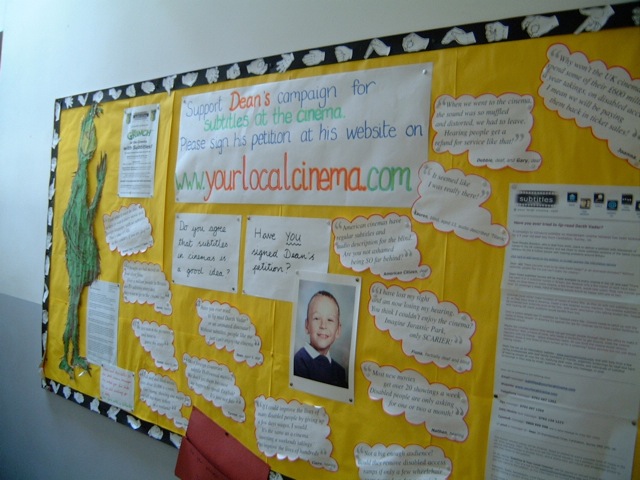
We organised a nationwide petition in UK primary schools to gather the views of deaf children and their families about accessible subtitled cinema.
The response was overwhelming. People across the country expressed their support for deaf children being able to enjoy the cinema alongside their classmates and friends. One school with just twelve deaf pupils gathered almost 1,500 signatures.
The petition, together with our surveys and reports on accessible films and screenings, helped the UK film industry compile its 2002 report:
“Cinema Access Technologies for People with Sensory Impairments”.
This work led directly to the UK's first
“Cinema Access Scheme”
— a plan to improve accessibility in cinemas using emerging digital cinema technology.
In 2004, impressed with the project, the UK film industry asked our non-profit social enterprise — YourLocalCinema.com — to run the marketing side of the scheme and promote accessible films and screenings across the UK.
Today, more than twenty years after my first English-language captioned cinema experience, almost all UK cinemas show a selection of films with captions each week. My friends and I can enjoy the cinema experience together.
Today the non-profit, multi-award-winning YourLocalCinema listings and information service is supported by organisations including the BFI and major film companies such as Disney and Warner Bros, and receives more than one million visits each year.
The service is unique because it allows film fans with hearing loss to quickly find exactly what they need: nearby subtitled/captioned screenings.
The site combines clear, smartphone-friendly listings with auto-location tools, accessible film trailers on YouTube, and a range of communication options including text messaging, email, live chat, Facebook, Twitter, WhatsApp and, if needed, sign-language conversations via Zoom.
Before 2000, many people with hearing loss could only follow films in cinemas by watching foreign-language films with subtitles. Today, thanks to collaboration between the UK film industry, YourLocalCinema and hearing-loss charities, most cinemas can provide accessible screenings.
In 2025, YourLocalCinema promoted more than 100,000 English-language captioned screenings of over 400 films across cinemas throughout the UK and Ireland. Thousands of film fans with hearing loss — often attending with friends or family — helped generate an estimated million admissions from captioned screenings.
Accessible, subtitled/captioned cinema screenings provide sociable benefits such as equality and inclusion. For a few hours, the disabling barrier is removed, enabling film fans with hearing loss to ENJOY, rather than endure the cinema experience
Dean
YourLocalCinema
AN AWARD-WINNING SERVICE!
Providing a popular, invaluable service to thousands of people has helped YLC win some high-profile awards voted for by the public, as well as its peers in the UK film industry. (YourLocalCinema gathers and maintains up-to-date market intelligence on everything cinema access/inclusion-related, including audience data, analytics and valuable customer feedback & surveys). Winning awards helps to spread awareness of accessible/inclusive cinema.

The Daily Mail 'People's Choice' Enterprise Award.
The event, hosted by the Institute of Directors, recognises people who have turned their ideas into reality. Thousands of Daily Mail newspaper readers voted for the twenty finalists and YourLocalCinema received the most votes overall.

The @diversity European 'Access Culture' Award. Implemented by the European Commission and presented at the EU Culture Forum in Brussels, the awards celebrate innovative ways of using technology to make culture more accessible across Europe. More than 250 projects were submitted.

The Barco 'Innovation in Cinema' Award. Part of the 'Raam Awards', which recognise and reward the efforts & achievements of people working in the UK film industry.

The British Telecom 'Remote Workers' Award honours people who manage to run a successful business without an office, using mobile technology. Judges selected the winner based on the company that demonstrated how remote working had created the greatest positive impact.
The BKSTS 'Samuelson' Award recognises and rewards the efforts & achievements of companies that have embraced technology or enhanced accessibility to ensure that cinema exhibition is available to all people.

Finalist: The National Lottery Awards recognise the difference that lottery-funded projects have made to local communities. YourLocalCinema beat hundreds of projects, with many thousands of votes, to make the finals. The ceremony was broadcast live, primetime, on BBC1, exposing millions of people to YourLocalCinema's audience development work, and accessible cinema in general.

Nominated: Cinema Marketing Campaign of the Year, 2018 Screen Awards. Run by Screen International, the awards recognise excellence in UK film marketing, publicity and brand partnerships, acknowledging the teams and individuals that contribute to the success of the British film industry.
"SEE the dialogue! HEAR the action! It's the accessible cinema experience!"
Accessible cinema screenings have made a positive, cultural, long-term impact on society. subtitles/captions benefit people of all ages. Each year in the UK, hundreds of children are born with significant hearing loss (NDCS). It's estimated that more than ten million, including thousands of young people, have hearing loss (RNID). Our society is ageing, and with ageing, loss of some hearing is inevitable. Access to film - via subtitles/captions - is something that we may all appreciate, eventually.
Feedback clearly indicates that opportunities to attend accessible screenings are very much appreciated by many. Click HERE for a selection of positive experiences from film fans who we have helped to discover - or rediscover - the joys of cinema-going.
YourLocalCinema's Twitter feed receives regular 'retweets' from companies/people with a high number of Twitter followers, which helps to publicise accessible cinema far and wide, which leads to many more people visiting the YourLocalCinema website, and signing up for the weekly email/twitter newsletter.
Recent 'retweets': @WarwickADavis (Star Wars actor) “What a brilliant service! Respect to you for taking the time to make cinema accessible to all” (Retweeted to more than 6100,000 followers); @cineworld (290,000); @ODEONcinemas (220,000); @BBCFilms (195,000).
Together, email and twitter help YourLocalCinema reach many thousands of film fans each week.

More subtitled/captioned Films & screenings
subtitled/captioned / subtitled/captioned Trailers

Cinema Locations

subtitled/captioned Cinema News
subtitles/captions glasses, Carers card, New cinemas & more...
Our Valued Sponsors
We simply couldn't exist without them...


Accessible, inclusive subtitled/captioned screenings enable film fans with hearing loss to ENJOY rather than endure cinema. For a few hours, the disabling barrier is removed. They provide sociable benefits such as equality, inclusion and community integration. There were more than a million admissions to accessible screenings in 2019!